
Last updated October 30, 2026
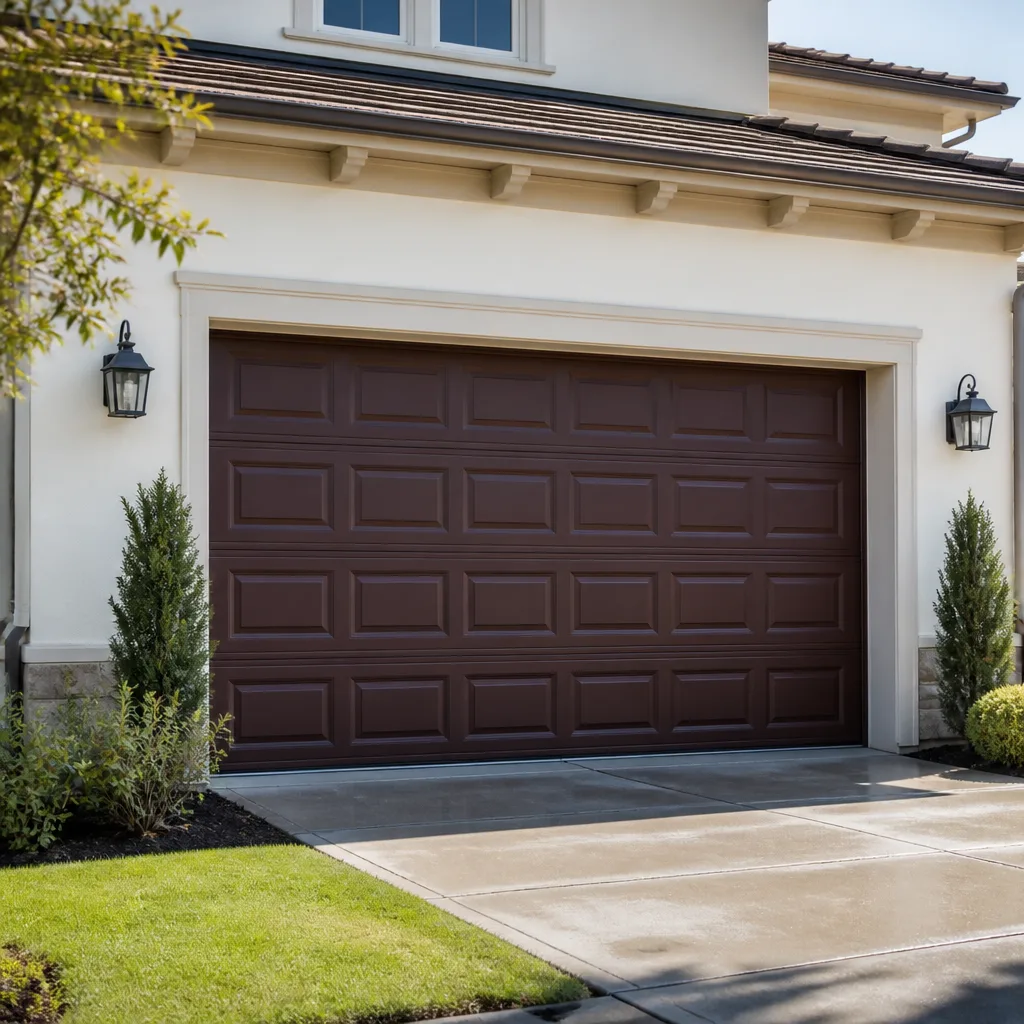 Raised-panel steel
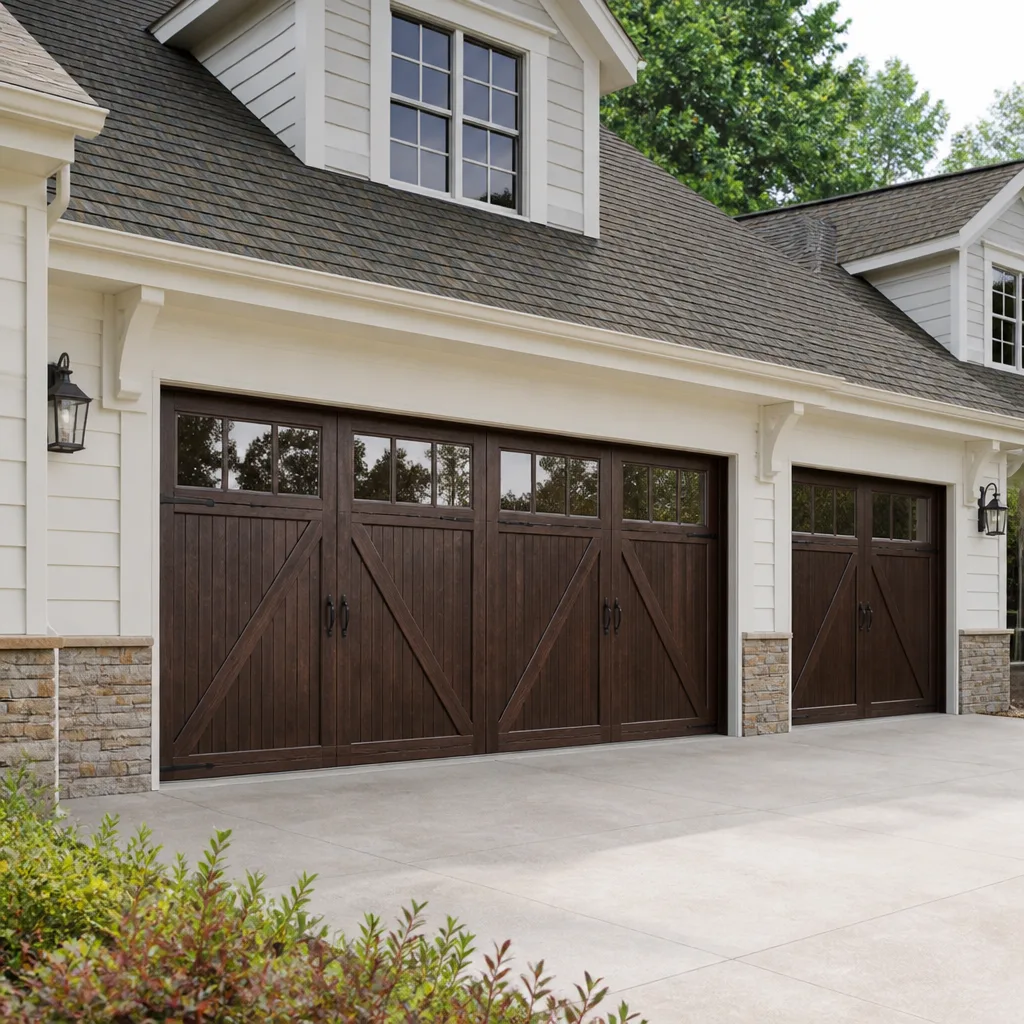 Carriage house
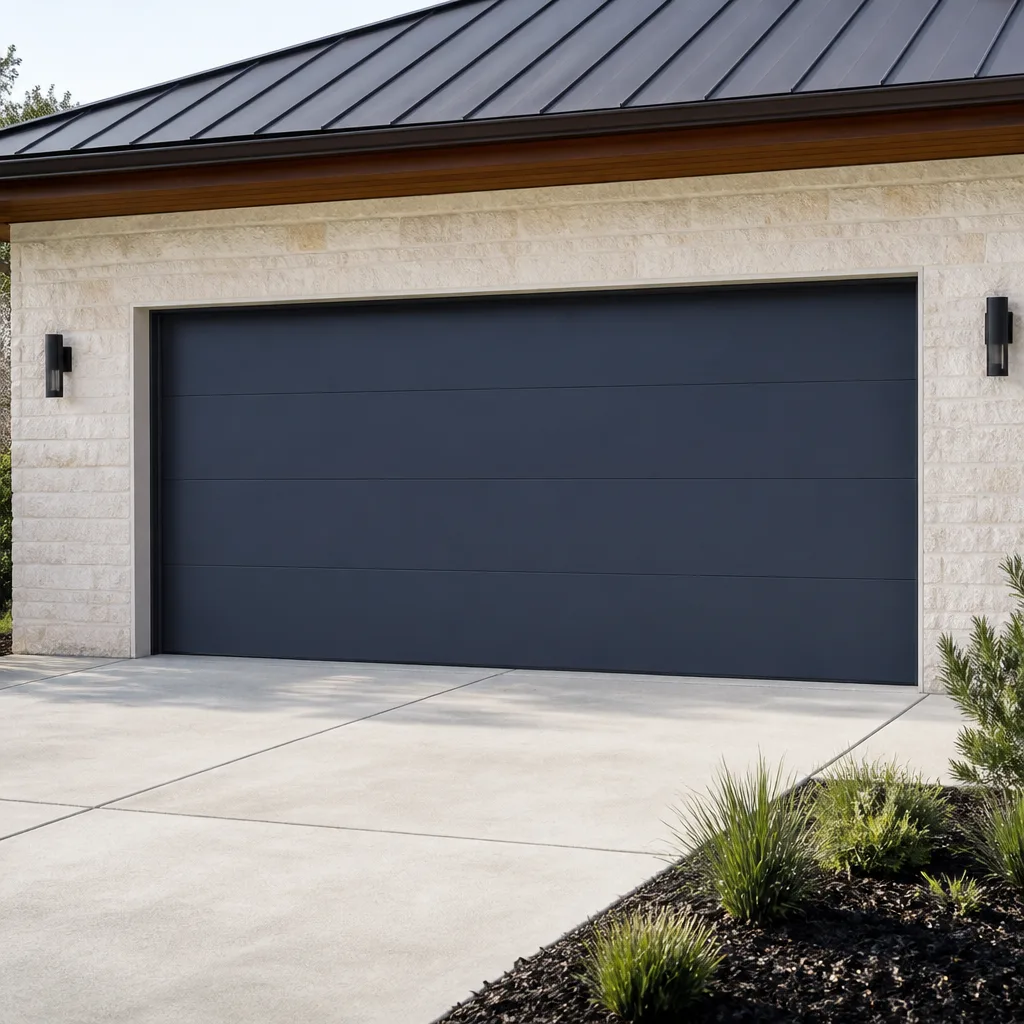 Modern flush
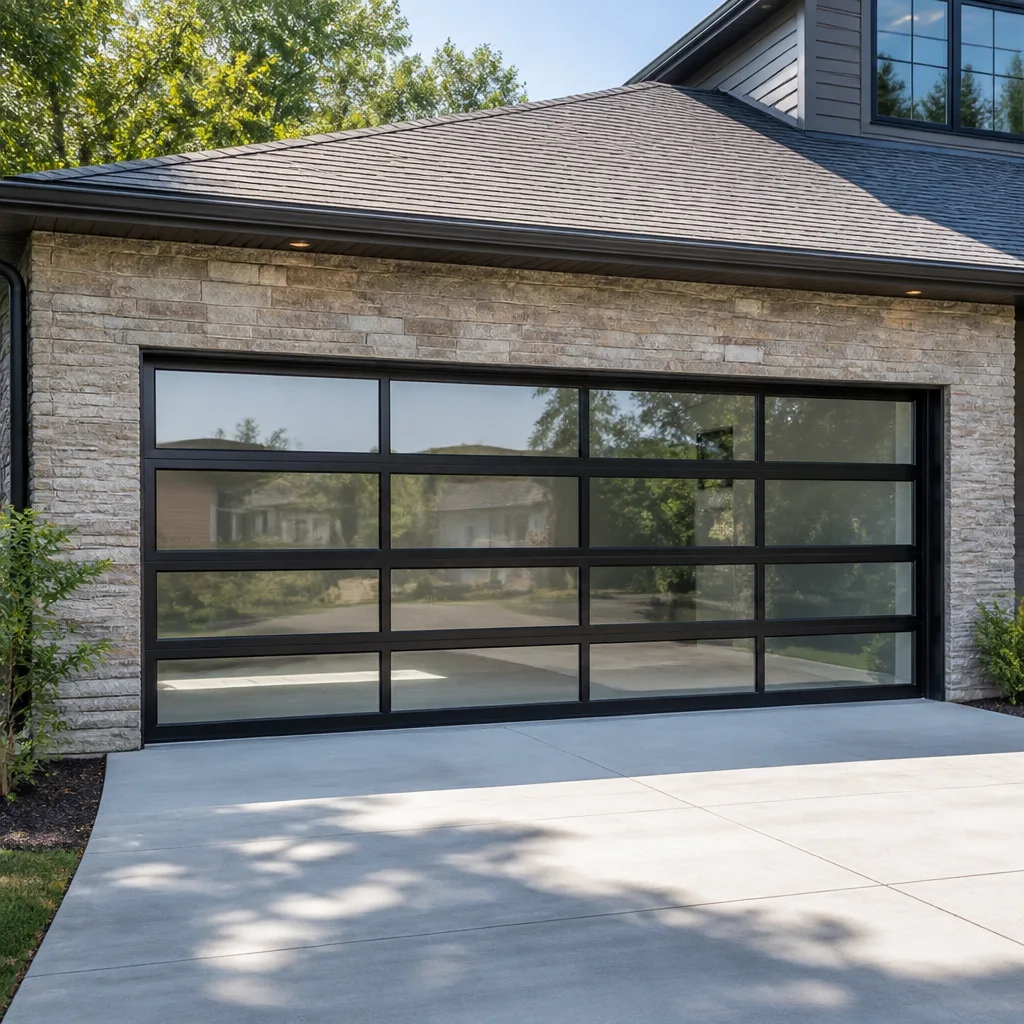 Full-view glass
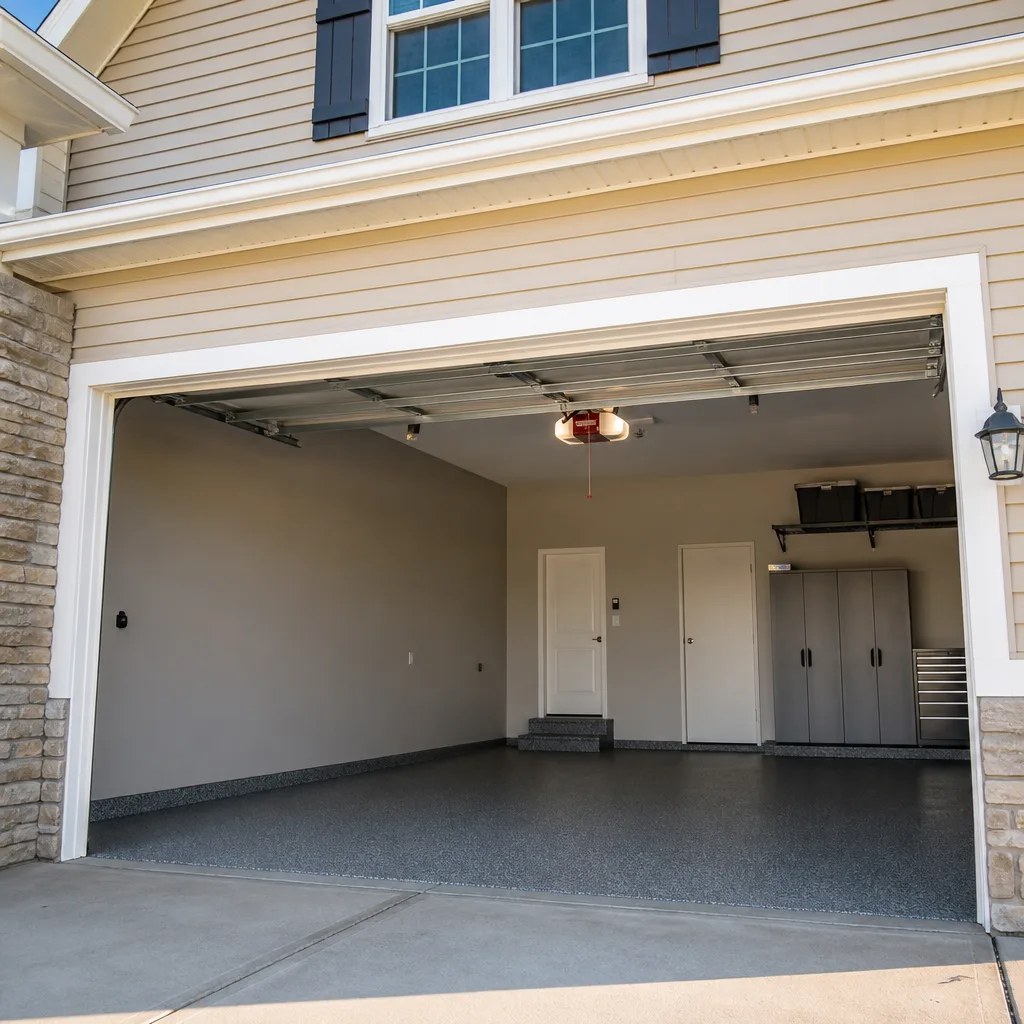 LiftMaster openers
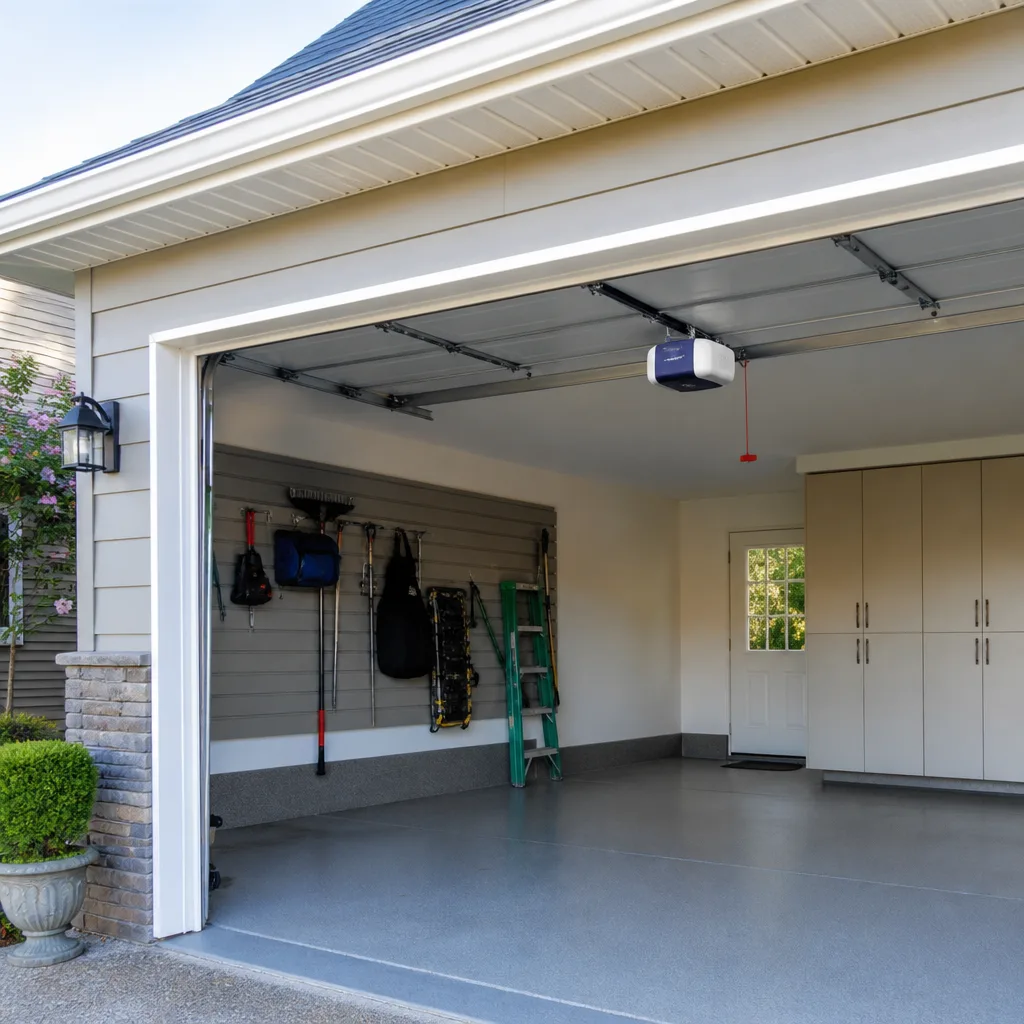 Chamberlain openers
Full 25-point door and opener safety check with every visit - springs, cables, rollers, tracks, and your LiftMaster or Chamberlain opener included
You get a price before we start. It does not change when the truck arrives.
Get your free estimateGarage Door Cost Breakdown: The San Bernardino Homeowner’s Reference for 2026
Two San Bernardino homeowners on the same street can get quotes for “spring replacement” that differ by $200 or more. Both quotes say “torsion springs,” both say “labor included,” and both come from licensed companies. The difference isn’t profit margin. It’s spring cycle rating. A 10,000-cycle spring costs less up front and wears out in about three years of normal use. A 30,000-cycle spring runs higher but outlasts the first option by a decade. This guide decodes every line item in a garage door estimate so you can tell whether a lower price reflects genuine efficiency or hardware that’s been quietly downgraded. We’ve spent years repairing doors across San Bernardino, and we’ve seen what happens to the cheap ones.
Quick Answer
Garage door repair costs in San Bernardino typically range from $125 to $450 for component-level fixes like cables, rollers, and springs, while full door or opener replacement runs $800 to $3,500 depending on materials, brand, and insulation. A spring replacement averages $180 to $340, a new opener installed runs $450 to $900, and a complete door replacement starts around $1,100 for a basic steel model. The single biggest cost variable isn’t labor – it’s the grade of hardware going into your door, and most quotes don’t disclose it.
Styles & brands we work with
Table of Contents
- Component-Level Costs: What Every Part Actually Costs in San Bernardino
- How to Read a Garage Door Quote: The Four Hidden Tells
- What the Lowest Bid Really Costs You Over Time
- Repair vs. Replace: The Calculation by Door Age
- San Bernardino-Specific Cost Factors: Why Local Matters
- Garage Door Opener Replacement: What Changes the Price
- Brand Compatibility: Why It Affects Your Estimate
- Step-by-Step: How to Compare Two Quotes Line by Line
Component-Level Costs: What Every Part Actually Costs in San Bernardino
Garage door systems are made up of roughly a dozen wearable components. When one fails, a technician quotes the part plus labor. The problem is that “one part” doesn’t mean one quality level. Here’s what we actually see in San Bernardino garages in 2026, broken into the economy tier and what we’d consider commercial-grade or heavy-duty hardware.
Torsion Spring Replacement
- Economy (10,000-cycle): $150 to $220 installed per pair. These springs use thinner oil-tempered wire and smaller inner diameters. They’ll handle about 8-10 years of light use, but in a San Bernardino summer where garage temperatures regularly exceed 100 degrees, heat accelerates metal fatigue. We’ve replaced economy springs in as little as three years on doors that cycle daily.
- High-cycle (25,000-30,000-cycle): $260 to $400 installed per pair. Powder-coated, thicker gauge wire, often galvanized. Rated for 15-20 years of normal use. Most manufacturers pair these with a longer labor warranty because they rarely fail prematurely.
- Extension springs (older doors): $140 to $190 installed. These are the long springs running along the horizontal tracks. They’re cheaper but more dangerous when they snap, and we strongly recommend safety cables run through the center if you have them.
Safety note: torsion springs hold hundreds of pounds of tension. Attempting to remove or adjust one without the proper winding bars and experience causes serious injury every year. This is one repair where the labor cost protects more than your door – it protects you. Call a trained professional.
Cable Replacement
- Standard 7-foot door, both cables: $160 to $250 installed. Includes re-balancing the door after install.
- Commercial-grade 1/8-inch galvanized cables: add $30 to $60 over economy. Thicker cables resist fraying at the bottom bracket, which is where San Bernardino’s dry, dusty air tends to accelerate wear by grinding grit into the cable strands.
- A cable that snapped due to a rusted bottom fixture: $220 to $320. The fixture itself needs replacement, not just the cable.
Roller Replacement
- Steel rollers (economy): $8 to $15 per roller installed, typically 10-12 rollers per door. They’re loud and they wear the track faster. Expect to replace them every 3-5 years.
- Nylon rollers with sealed ball bearings (recommended): $15 to $25 per roller installed. Quieter by a noticeable margin and they don’t grind the track. We install these as standard on most repair jobs because the price difference is small and the performance gap is large.
- Full roller swap, entire door: $120 to $260 installed, depending on roller type and door weight.
Panel Replacement
- Single steel panel, non-insulated: $250 to $450 installed. Matching color and texture is the challenge – factory paint batches vary, especially on doors older than five years.
- Single panel, insulated (polyurethane or polystyrene core): $400 to $700 installed. If your door faces west in San Bernardino, the insulated panel pays for itself in reduced heat transfer into an attached garage.
- Bottom panel with water damage: add $75 to $125 for new weather seal and retainer. San Bernardino’s occasional heavy rain events cause more bottom-panel rot than most homeowners expect.
Track and Hardware Adjustment
- Track realignment and tightening: $90 to $150. A door that rumbles and shakes during operation is often a track issue, not a spring issue.
- Hinge replacement (per hinge): $20 to $40 installed. Center hinges take the most stress. A failed hinge cascades into track damage if ignored.
- Weather seal replacement (bottom): $80 to $130 installed. Keeps dust, water, and San Bernardino’s aggressive summer heat out of the garage.
These ranges reflect what we see on service calls throughout San Bernardino in 2026. If a quote comes in dramatically below the low end, that’s not efficiency – that’s a different product or a skipped step. The next section shows you how to spot which one.
For a full breakdown of what’s included in a standard service call, see our page on garage door repair in San Bernardino.
How to Read a Garage Door Quote: The Four Hidden Tells
Most garage door quotes are written as line items with a part name and a price. They rarely specify the grade of hardware going in. That’s where the cost difference hides. Here are the four things to check before you sign anything.
- Spring cycle rating: If the quote says “torsion springs” without a cycle rating, you’re being quoted for the cheapest springs the company stocks. High-cycle springs (25,000+) are a selling point – a company that installs them will say so. If it’s not on the quote, ask. This single detail can account for a $150 gap between two “identical” spring replacement bids.
- Roller material: A quote that lists “rollers” without specifying nylon or steel is telling you something by omission. Steel rollers are half the price and twice the noise. In a San Bernardino home where the garage sits under a bedroom, that choice matters daily.
- Cable gauge and coating: Economy cables are typically 1/8-inch diameter with a basic galvanized coating. Heavy-duty cables are 5/32-inch and often stainless or extra-galvanized for the high-dry-heat environment. A cable replacement under $150 almost certainly uses the thinner gauge.
- Labor warranty duration: This is the tell that matters most. A company that installs quality hardware stands behind it for a year or more. A company that installs budget parts offers 30 or 60 days. Labor warranty duration is the best proxy for the installer’s confidence in the parts they sell.
When we write a quote in San Bernardino, the hardware grade goes on the line item. Not because we’re required to, but because homeowners deserve to know whether they’re comparing a 10,000-cycle spring to a 30,000-cycle spring. The lowest quote isn’t always the cheapest. The next section shows the math.
What the Lowest Bid Really Costs You Over Time
Let’s run the numbers on a real scenario we’ve seen repeatedly in San Bernardino: a homeowner gets three quotes for spring replacement. The low bid is $180. The high bid is $340. The homeowner takes the low bid and saves $160. Three years later, that economy spring fractures – same as the original – and now the repair costs $210 because part prices have gone up. Over six years, the homeowner has spent $390 and faced two unexpected breakdowns. The $340 high-cycle spring is now in year six of a 15-to-20-year lifespan, and the homeowner hasn’t thought about it since installation day.
The lowest bid also tends to skip diagnostic work. A technician quoting $180 for springs is unlikely to spend time checking track wear, cable condition, or hinge integrity – they’re in and out in 45 minutes. The actual cause of your original spring failure (sometimes a stiff roller or bent track putting extra load on the spring) remains unaddressed, so the new spring inherits the same problem.
Then there’s the callback rate. Nationally, garage door repair callbacks run anywhere from 5 percent for quality-focused shops to 20 percent or more for volume-based operations. Every callback means another morning off work, another service window, another interruption. That’s a cost no quote shows but every homeowner pays.
We keep our callback rate low by doing the diagnostic work on the first visit and installing hardware we’d put on our own homes. Garage doors are all we do – the repair isn’t a side stop on the way to a plumbing job. It’s the entire appointment. That focus changes what gets checked and what gets caught before it becomes the next breakdown.
If you’re weighing a repair against ongoing maintenance costs, see our Garage Door Repair in San Bernardino page for what a full inspection covers.
Repair vs. Replace: The Calculation by Door Age
A repair bill of $400 feels like a lot until you compare it to a $1,800 replacement. But at some point, repairs become a subscription service for a door that’s ready to retire. Here’s the framework we walk San Bernardino homeowners through when they ask whether to fix or replace.
Doors 0-7 Years Old: Repair
If your door is under seven years old, repair almost always wins. The panels, tracks, and hardware are still within their expected service life. A spring failure at year five is normal wear – replace with high-cycle springs and you’ll get another decade or more out of the door. The exception: a car impact that bends multiple panels or warps the track. In that case, the repair math can approach 60-70 percent of replacement cost, and replacement starts to look better.
Doors 8-15 Years Old: The Judgment Zone
This is where most San Bernardino doors sit, and it’s where the honest answer is “it depends.” Ask yourself these questions:
- How many repairs in the last two years? If you’ve replaced springs twice, a cable, and three rollers, you’re north of $600 in maintenance. That trend line only goes up.
- What’s the panel condition? Dents, rust at the bottom edge, and faded or peeling paint don’t affect function but they do signal age. A door with cosmetic damage isn’t worth a $400 component investment if replacement is $1,400.
- Is the door insulated? An uninsulated door in a San Bernardino summer turns an attached garage into an oven, which then heats the adjacent living space. Replacing a mid-life door for energy reasons alone is legitimate if the garage is attached and the current door is single-layer steel.
- Are parts still made for it? Some door models from the 1990s and early 2000s have discontinued hardware. When a proprietary hinge or roller bracket fails and the part is no longer manufactured, the repair requires modification – and modification is expensive.
Doors 16+ Years Old: Plan for Replacement
At 16 years or more, the door itself – panels, frame seals, track system – has outlived its design life. Springs will fail more frequently regardless of grade because the door’s moving weight and balance change as panels degrade and tracks wear. A full replacement with a modern insulated door from Clopay or Amarr typically runs $1,100 to $3,500 installed in San Bernardino, and it resets the clock on every wearable component at once. Compare that to $500-$700 per year in piecemeal repairs on an aging door, and the replacement wins the three-year math.
For a complete guide to new door options and pricing, visit our Garage Door Installation in San Bernardino page.
San Bernardino-Specific Cost Factors: Why Local Matters
Garage door pricing isn’t uniform across Southern California. San Bernardino has three characteristics that affect what you’ll pay, and two of them are invisible to out-of-area companies quoting over the phone.
Heat and metal fatigue. San Bernardino summers routinely push garage interior temperatures past 110 degrees. High heat accelerates the fatigue of spring steel, which is why we recommend high-cycle springs for any door that’s cycled more than twice a day, and why economy springs sometimes fail here years earlier than they would in a coastal city. A company that doesn’t operate in this climate won’t adjust their hardware recommendations for it.
Dust and dirt. Inland Empire air carries fine particulate that works its way into tracks, rollers, and hinges. Rollers with sealed bearings resist this; economy steel rollers load up with grit and grind the track. Replacing worn rollers before they wear the track is a $200 job. Replacing a worn track is a $400+ job. It’s the kind of preventative detail a local shop notices because we see it on every third service call.
Out-of-area service fees. This is the one most homeowners don’t catch. A company based in Riverside or Ontario quoting a repair in San Bernardino often adds a trip charge or “extended service area fee” of $25 to $75 that isn’t itemized clearly – it’s folded into the labor line. A San Bernardino-based company doesn’t pay that travel overhead and doesn’t pass it to you, which is part of why a local specialist can often beat an out-of-area quote on the exact same repair using the exact same parts.
Companies like ours that work exclusively on garage doors in San Bernardino also keep inventory calibrated to what’s actually installed in local homes. We know that a 2003-era tract home in the north side likely has an extension-spring system, while a 2015 build near Cal State has torsion hardware. We stock for both. An out-of-area company makes two trips: one to diagnose, one to install after the part arrives.
Explore our full range of services starting at San Bernardino Garage Door Co home.
Garage Door Opener Replacement: What Changes the Price
Openers are the most under-specified component in a garage door system, and the price range reflects it. A basic chain-drive opener installed in San Bernardino runs $450 to $550. A belt-drive unit with battery backup, Wi-Fi connectivity, and a DC motor runs $700 to $900 installed. Both open the door. That’s where the similarities end.
Chain-drive openers are workhorses – they’re what most homes have, and they’ll run for years with minimal attention. They’re also loud. If your garage sits under living space, the rumble travels through the ceiling joists. In a two-story San Bernardino home, that’s the difference between an opener you notice every morning and one you forget exists.
Belt-drive openers from LiftMaster and Chamberlain use a reinforced rubber belt instead of a chain. They’re meaningfully quieter and the price premium – typically $150 to $250 over a comparable chain-drive – buys you a decade of not hearing the door open at 6 a.m. For homes with a bedroom over the garage, we recommend belt-drive without hesitation.
That’s why we treat opener repair as its own dedicated service, not an add-on to a main-door repair. The electronics in a modern opener – the logic board, the RPM sensors, the force-detection circuitry – bear no relationship to the mechanical parts they drive. A technician who’s great at springs might have no idea how to diagnose a Genie limit-switch fault. We work on garage door opener repair in San Bernardino every week, and the diagnostic flow for an opener issue is completely different from a mechanical door repair.
If your opener is over 12 years old and the logic board fails, replacement beats repair in most cases. A new board runs $150 to $250 plus labor, while a new opener runs $450 to $650 installed with a fresh warranty. The old opener’s motor and gearbox are near end-of-life anyway. The repair math favors replacement once the board goes.
Brand Compatibility: Why It Affects Your Estimate
Every garage door company can hang a new door. Far fewer can diagnose and repair the door you already have, with the opener it’s attached to, without proposing to replace things you don’t need replaced. That’s where brand fluency changes the price you pay.
Here’s a real scenario we see in San Bernardino: a homeowner calls about a door that reverses immediately after hitting the floor. A generalist hears “reverses” and assumes a sensor issue – maybe a misaligned photo eye. It’s a safe guess and it’s wrong about half the time. A technician who’s worked on hundreds of LiftMaster and Chamberlain openers knows that a door reversing at floor level often means the close-force setting drifted, or the travel-limit module has a fault. Same opener family, different root cause, completely different repair cost. The generalist replaces the sensors for $180, and the problem comes back in two weeks. Then they come back and guess again.
We repair and install across eight major brands – including LiftMaster, Chamberlain, Genie, and Clopay – because that’s what’s actually installed in San Bernardino homes. A single-brand dealer forces every diagnostic into their own product line. If you have a Genie opener and a Clopay door, they’ll tell you the Genie is the problem because that’s what they’re set up to sell. We work on the brand you already have, from panel to opener to spring.
Brand compatibility also matters for parts availability. A Wayne Dalton door uses different hinges and brackets than a Clopay door, and mixing them creates fitment issues. A shop that stocks or has rapid access to the right brand’s hardware fixes the door correctly the first time, without an adapter, without a rigged bracket, and without a return visit.
If you’re in the market for a full system upgrade, our Garage Door Installation in San Bernardino page covers what we install and how we price it.
Step-by-Step: How to Compare Two Quotes Line by Line
Most homeowners compare quotes by looking at the bottom-line number. That’s the single worst way to do it. Here’s the method we recommend, step by step:
- Circle the part names. Both quotes should name the same parts. If one says “spring replacement” and the other says “torsion spring replacement – 30,000-cycle,” those are different products. The first quote is hiding something.
- Check the hardware specs. Cycle rating for springs. Nylon vs. steel for rollers. Cable gauge for cables. If it’s not specified, it’s economy-grade. Ask for a written amendment specifying the grade before you sign.
- Look at the labor warranty. 30 days means budget parts. 90 days means mid-grade. 1 year or more means the company stands behind the hardware. This is the single strongest signal of what you’re actually getting.
- Check for itemized labor vs. parts. A quote with a single number and “labor and parts included” gives you no way to verify what’s being installed. Itemized quotes are harder to game.
- Look for the diagnostic line. A good quote includes a diagnosis or inspection line covering the time spent finding the actual problem, not just replacing the obvious part. If the quote jumps straight to the repair, the technician hasn’t diagnosed anything yet.
- Compare the total against the ranges in this guide. If the quote is below the low end of the range for that repair, that’s a red flag, not a bargain. If it’s above the high end, ask why. Either way, the answer should be specific and written down.
- Confirm the price before work starts. Any reputable company in San Bernardino quotes a firm price before the first tool comes out. If a technician arrives with an open-ended quote and says “we’ll see how it goes,” send them packing. You’ll never see the original number again.
This method takes 15 minutes and it separates the estimates you can trust from the ones that are guessing. The right repair, not just the fast one.
Common Mistakes to Avoid
- Accepting a quote without hardware specs. A “spring replacement” quote without a cycle rating is a quote for the cheapest possible spring. You won’t know it until it fails in three years.
- Choosing by price alone. The $180 spring bid saves money on day one and costs more by year four. Garage door repair is one category where the cheapest quote is usually the most expensive choice over time.
- Decorating the garage door after a spring failure. When a spring snaps and the door hangs crooked, many San Bernardino homeowners call a handyman who “works on doors sometimes.” The handyman replaces the spring. The door still binds because the track bent when the spring let go. Spring repair requires a track inspection as part of the job – it’s not a standalone fix.
- Ignoring the rollers because “they still roll.” Rollers that still roll can still be worn. A roller with a flattened bearing grinds the track instead of rolling on it. By the time it visibly fails, you’re replacing a track, not a roller.
- Replacing an opener when the problem is the force setting. We can’t count how many Genie and Chamberlain openers get replaced every year because a sensitivity adjustment drifted and the door reverses randomly. A diagnostic visit is $89. An opener replacement is $600. Diagnose first.
- Using WD-40 on everything. WD-40 attracts dust and gum up hinges, especially in San Bernardino’s dry, dusty air. Use a silicone-based lubricant on rollers and hinges, and keep the WD-40 for the car.
- Waiting for the second spring to fail. Torsion springs are installed in pairs and they wear at roughly the same rate. Replacing only the broken spring saves $80 now and guarantees a second service call – at a new trip fee – within a year.
See the difference
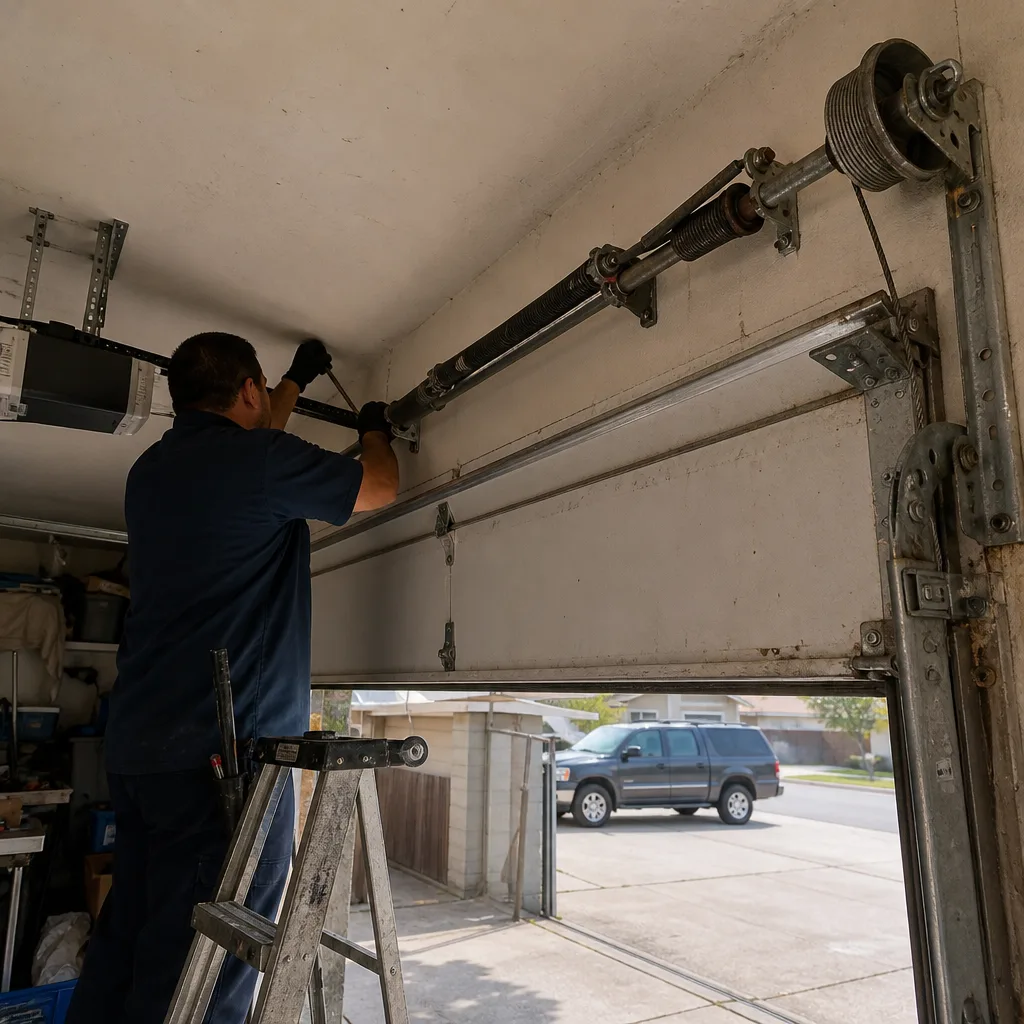 Before
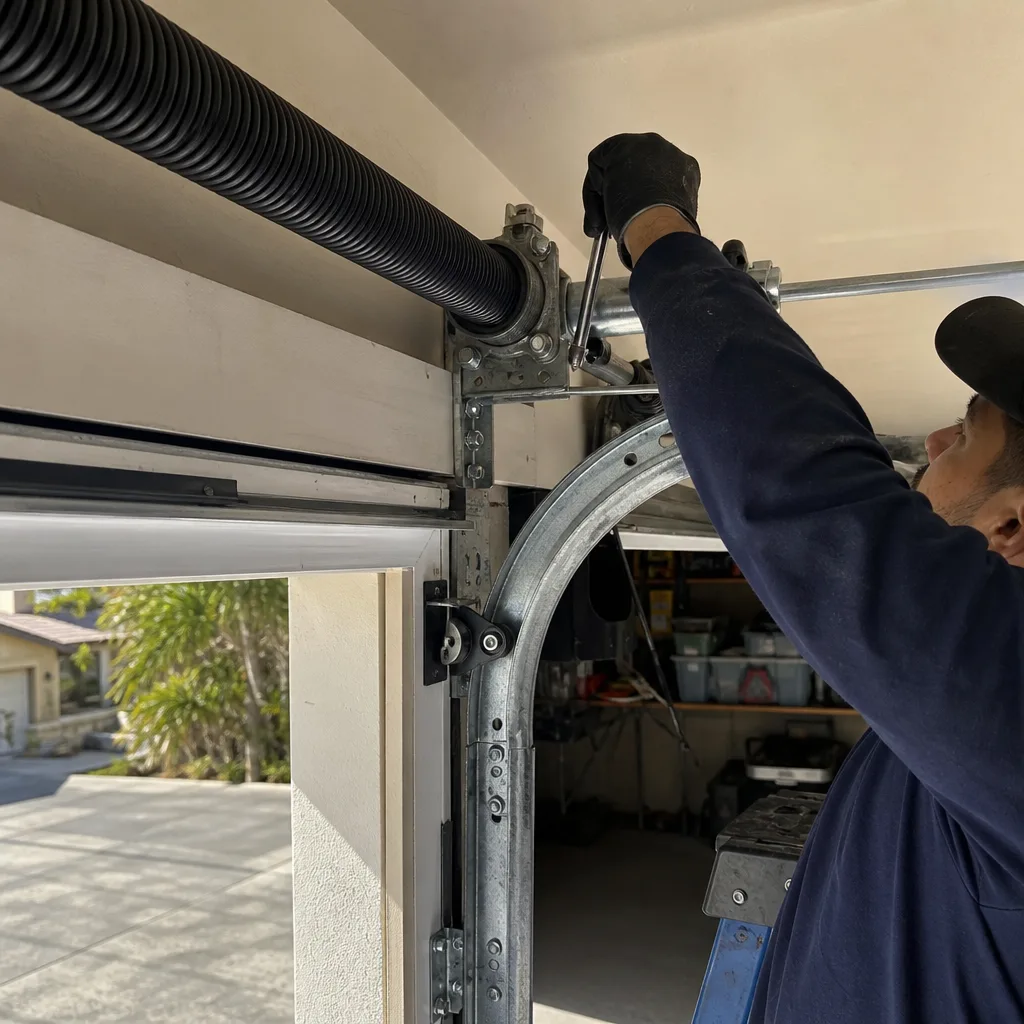 After
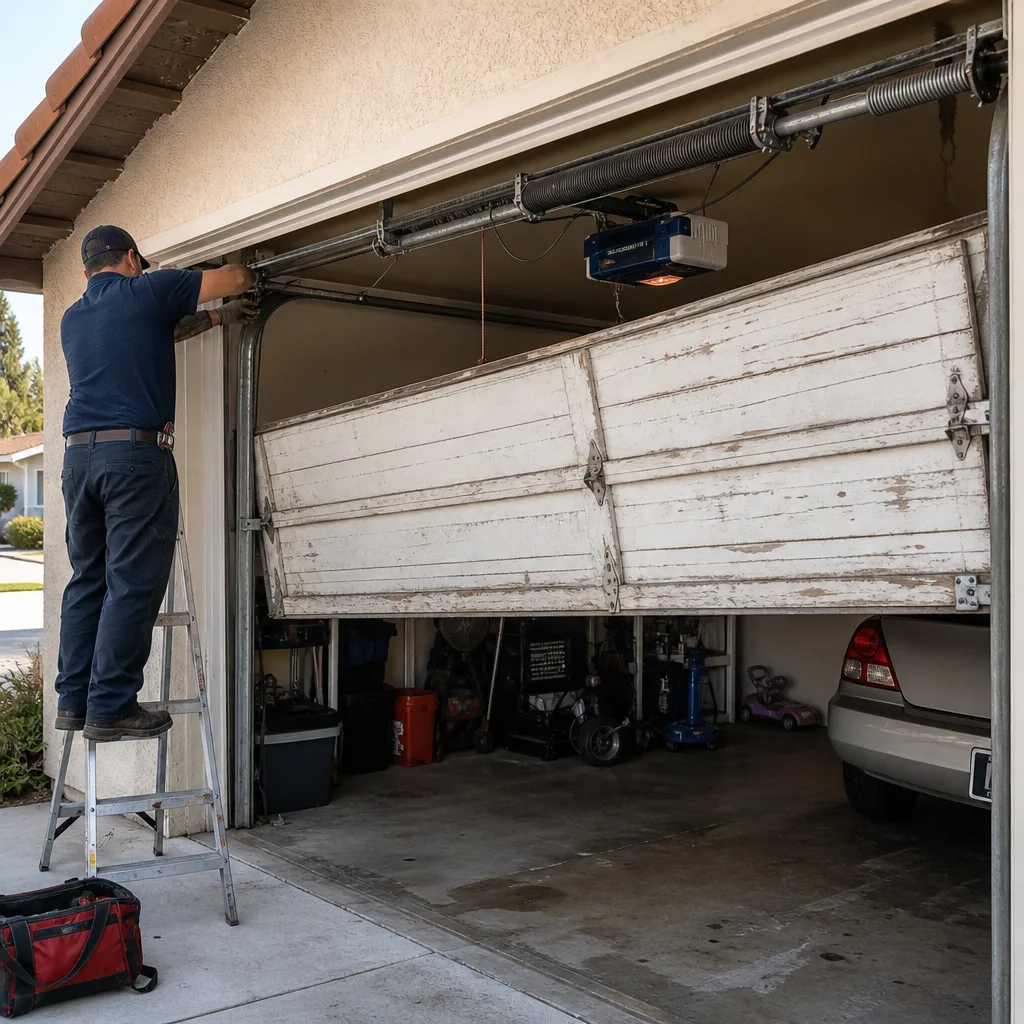 Before
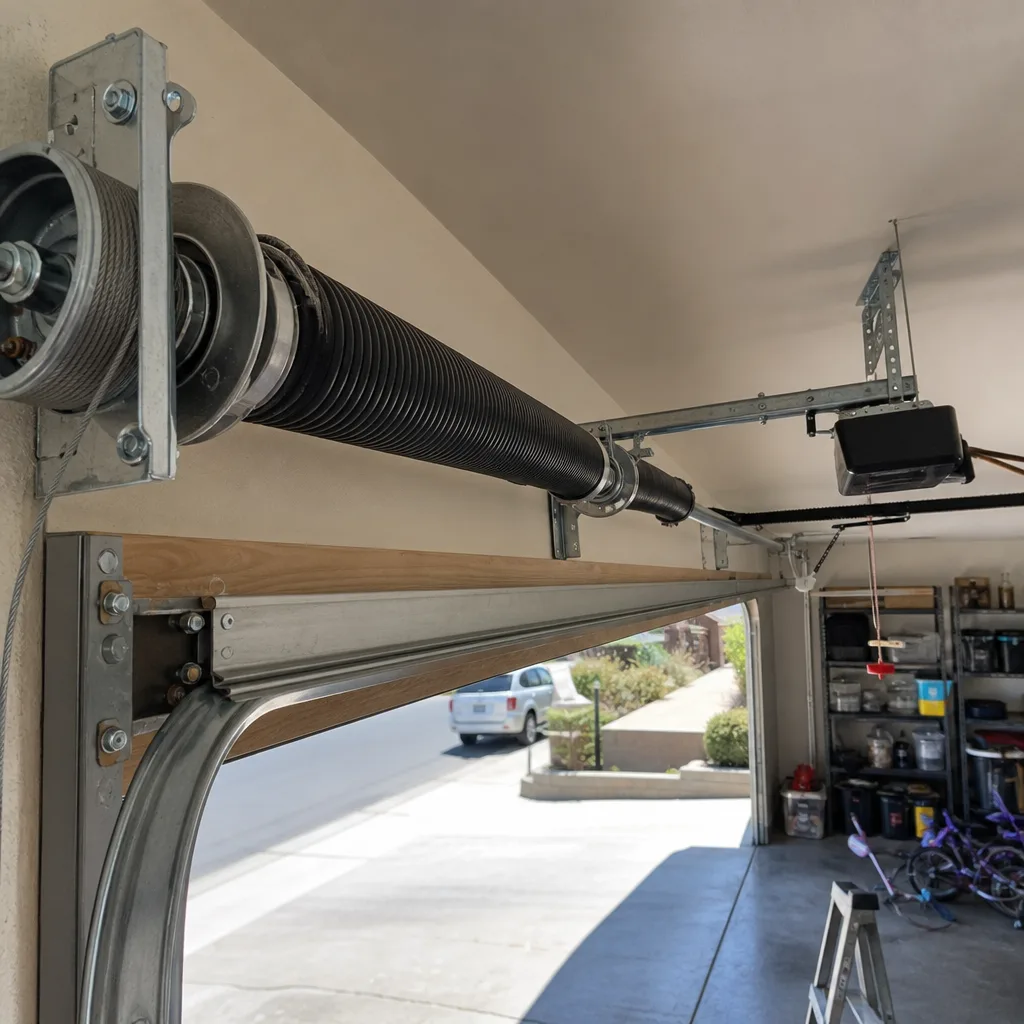 After
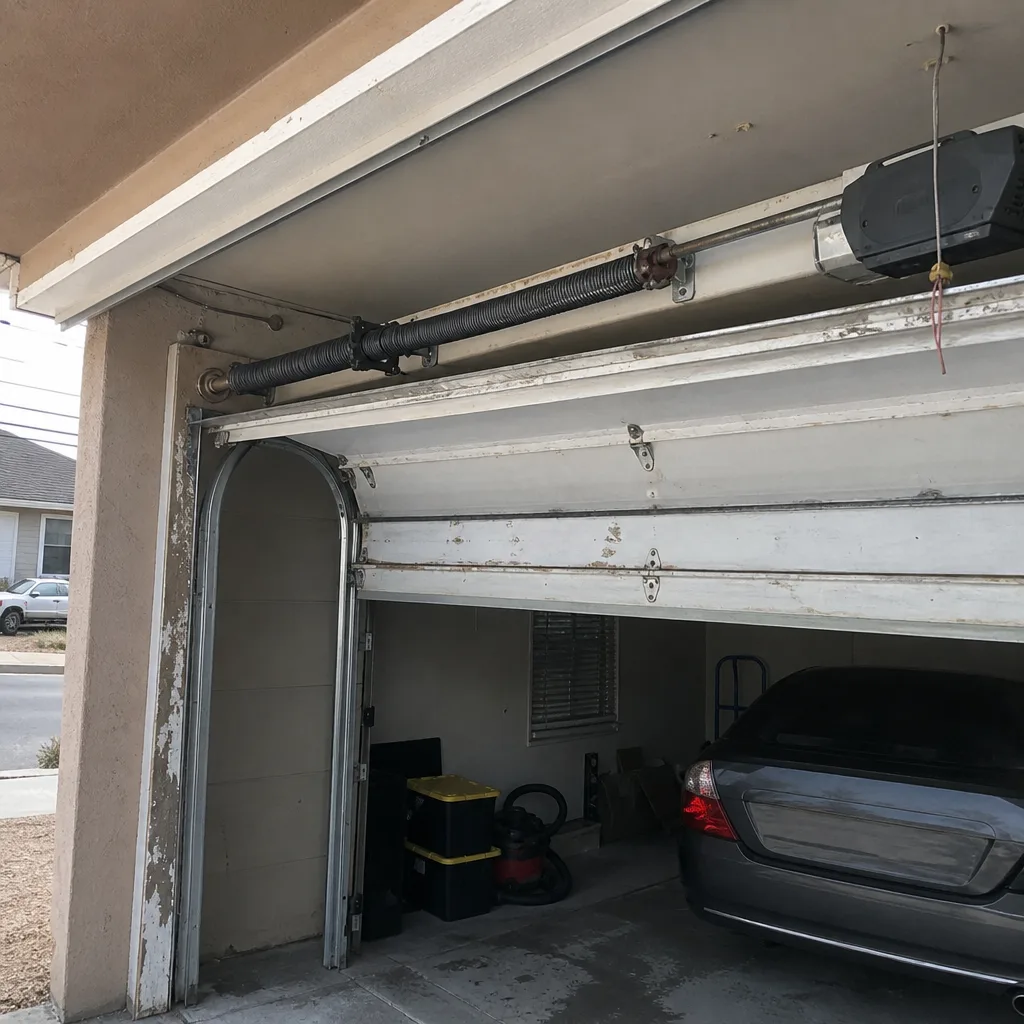 Before
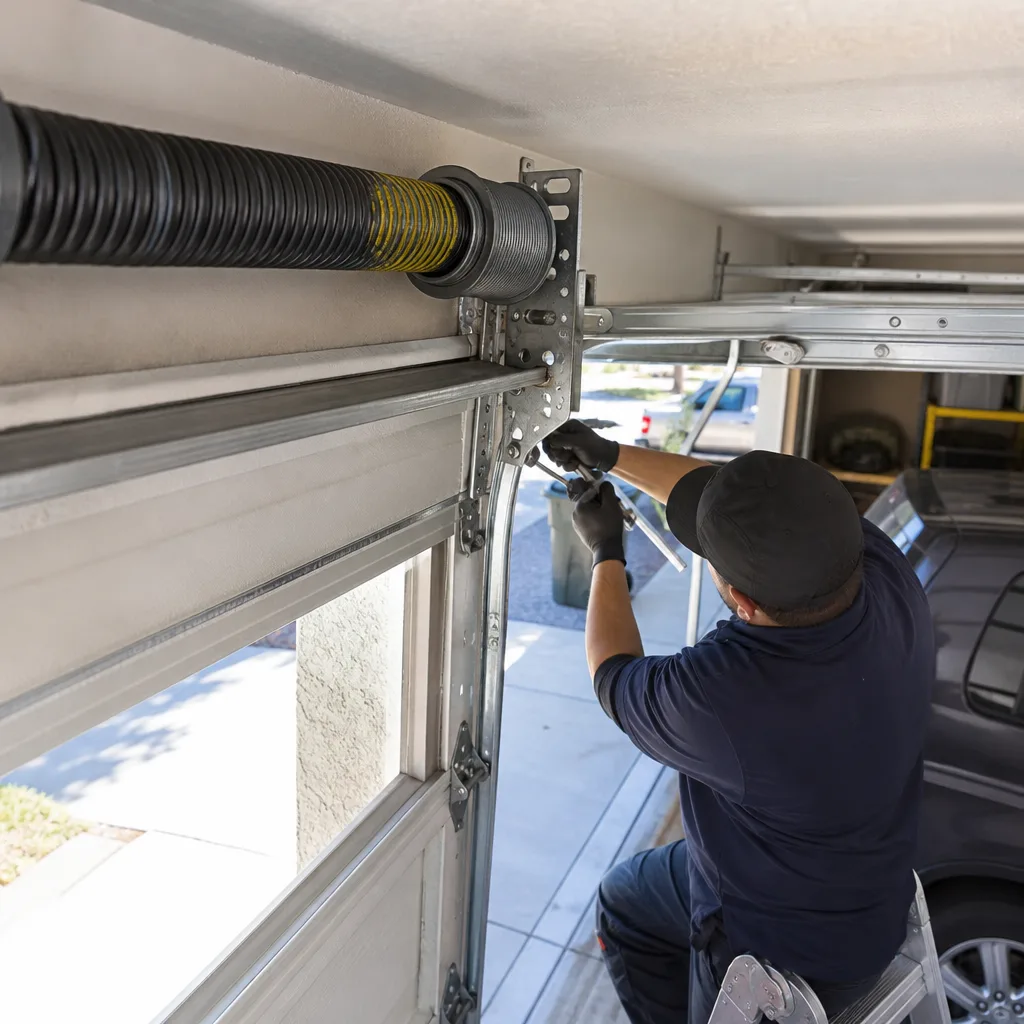 After
When to Call a Professional
If your garage door makes a grinding sound during operation, shakes on the way down, or hangs unevenly in the tracks, you’re past the point of adjustment videos and homeowner forums. These are symptoms of a mechanical system running against its own tension, and the failure mode is never gentle. A spring that releases unexpectedly is a life-threatening event, not a household nuisance. Cables under tension should be treated the same way. If you’re unsure whether you’re looking at a simple fix or a compound failure, that’s exactly when to call someone who works on garage doors every day. San Bernardino Garage Door Co offers free estimates in San Bernardino – call (855) 763-8905 and we’ll look at your door, give you a written quote with hardware specs, and confirm the price before any work starts.
Frequently Asked Questions
Spring replacement in San Bernardino typically runs $180 to $400 per pair installed, depending on the spring cycle rating and wire gauge. Economy 10,000-cycle springs sit at the low end; high-cycle 25,000 to 30,000-cycle springs run higher and last three times as long. We always quote the cycle rating so you know which spring is going on your door.
Yes. Most repairs – springs, cables, rollers, openers – use parts we stock on the truck, so we can usually complete the repair on the first visit. For uncommon door or opener models, we source the part and return within one to two business days. Call (855) 763-8905 and we’ll tell you which category yours falls into.
No. We quote a firm price before work begins and we honor it. The only thing that changes a quote is discovering an additional problem we didn’t know about, and if that happens, we show you the issue and get your approval on the new number before touching anything else.
Yes. Our trucks in San Bernardino are stocked with springs across multiple cycle ratings and wire gauges, cables in standard and heavy gauges, nylon and steel rollers, hinges, brackets, and openers from LiftMaster, Chamberlain, and Genie. Most jobs wrap up on the first appointment.
At 15 years old, most San Bernardino doors are approaching the end of their service life, and replacement often makes more financial sense if repair costs are stacking up. A mid-sized repair on a 15-year-old door runs $300 to $500, while a new entry-level door installed starts around $1,100 and resets the clock on all components at once. The right answer depends on the door’s overall condition – an inspection tells you which side of the math you’re on.
Opener repair in San Bernardino averages $150 to $350 depending on the fault. Gear replacements and limit-switch adjustments sit at the low end; logic board and motor replacements run higher. If the opener is older than 12 years, we’ll show you the replacement math and let you decide. Our Garage Door Opener Repair in San Bernardino page breaks it down component by component.
The Bottom Line
Garage door pricing in San Bernardino rewards the homeowner who asks questions. The four tells – spring cycle rating, roller material, cable gauge, and labor warranty duration – reveal everything a quote is trying to hide, and they’re almost never volunteered. A low bid on paper is usually a higher bill over five years, and that’s before you count the inconvenience of unexpected breakdowns in the middle of a San Bernardino summer. Get the hardware specs in writing, confirm the price before work starts, and choose a company that works on the brand you already have, not the one it’s trying to sell you. From panel to opener to spring, the door you have deserves a specialist who knows it.
Written by the team at San Bernardino Garage Door Co, serving San Bernardino since 2016.